3D Modeler / CG Generalist
Have you decided where to go for your internship? When I applied to internships in my junior year in college, I realized I would like to try applying to ones in Japan. However, I soon realized there isn't a lot of information about applying to internships in Japan. This blog will share my experience of finding an internship, actually going to Japan, and staying there for two months!
How I got my Internship at Japan
Have you decided where to go for your internship? When I applied to internships in my junior year in college, I realized I would like to try applying to ones in Japan. However, I soon realized there isn't a lot of information about applying to internships in Japan. This blog will share my experience of finding an internship, actually going to Japan, and staying there for two months!
Dec 13, 2022

Preparations for Applications
My first tip to internships applications would be making connections. When I decided to apply for internships in Japan, my first obstacle was to write a whole page of resume in Japanese. As someone whose Japanese was completely self-taught, this was an extremely difficult task. My solution was contacting alumni who are currently working in Japan on LinkedIn. Luckily, an alumnus at my school replied to my message and agreed to proofread my resume! Hence, remember that reaching out to alumni is definitely worthwhile whenever you get stuck in your career.
The First Step: Resume
Writing a resume in a second language could be tricky, since the standards and expectations could be completely different. For applying to a job at Japan, you will need two documents:
1. Japanese Resume (Rirekisho / 履歴書): includes your basic information (name, date of birth, address, etc.) and background (education and work experience)
2. Japanese CV (Shokumu-keirekisho / 職務経歴書): includes details of your past work experience (company you worked at, job description, etc.)
For me, I only submitted a Rirekisho and not a Shokumu-keirekisho when I applied, because at that point, I didn't have any work experience. Most students who apply to internships do not have actual work experiences, so it's fine to not have a Shokumu-keirekisho. However, if you are only submitting a Rirekisho, you will need to make sure to appeal as much as possible in the Rirekisho, or else it might seem like you are lacking skills.
Here is a website with templates to download and a step-by-step tutorial on writing a Rirekisho:
https://www.gtalent.jp/blog/japanwork-en/job-hunting-en/rirekisho-en
Finding Job Postings
There's various websites that have job postings from all over the world, such as LinkedIn. However, keep in mind that there's also Japanese job posting websites. Here are some:
https://job.rikunabi.com/2023/
Other than job posting sites, you can also search for the companies you are interested in, and take a look at their sites. Some companies have application forms you can fill in directly on their sites, and some only have their contact information such as email.
Writing Formal Emails
I found my internship on 求人ボックス and proceeded to contact them via email. There are various cases for this. For my situation, I already made sure they had internship opportunities when I contacted them. For other cases, I was interested in the company, but do not know whether they have internship opportunities. If that's the case, don't hesitate to ask them whether they are accepting internships.
Writing formal emails in Japan is extremely different from the ones we write in the United States. Please keep in mind that there’s an entire culture and etiquette surrounding digital correspondences in Japanese. Even if you are fluent in the language, you might not know the correct way to write a formal email.
Here are some useful websites with examples:
https://www.wasabi-jpn.com/japanese-lessons/how-to-write-emails-in-japanese-with-practical-examples/
https://cotoacademy.com/ultimate-guide-japanese-business-emails/
Also remember that it is extremely normal when you don't get a response. Companies are extremely busy, so it happens a lot. I wrote to around 10 companies, and I heard back from around half of them. For the ones with application forms on their sites, it is even more unlikely to get a reply.
Preparations to Enter Japan
After you nailed your internship application, there are still a lot of things to prepare before your arrival in Japan! It isn't just about booking flights, but there's also complicated steps to take.
Applying for a Visa
With the pandemic going on, the regulations regarding Visa applications keep changing, so keep in mind that what I share about my Visa application process might be different to what you will be going through!
However, generally speaking, when I applied to get a Visa in June 2022, that is when the COVID regulations started to lift a bit, but there were still several restrictions. Unless another pandemic breaks out again, your application process will definitely be easier than mine.
Check out the Ministry of Foreign Affairs of Japan site for latest information:
https://www.mofa.go.jp/j_info/visit/visa/index.html
There are several kinds of Visa one could get; however, there's only two kinds of Visas interns like us would be looking into.
1. Work Visa: issued to foreigners who wish to take up paid employment in Japan.
2. Short-Term Stay Visa: issued to foreigners who wish to stay up to 90 days in Japan for tourism, (unpaid) business, and visiting friends or relatives
For detailed list of all kinds of Japan Visa:
https://visaguide.world/asia/japan-visa/
Back in June 2022, I applied for a Short-Term Stay Visa, since my internship is not paid. Also, I was planning to stay for 2 months, which means 90 days is definitely enough for me. After checking this with my employer, I had to give them my basic information (name, birthdate, address, etc.) for them to fill out the *Entrants, Returnees Follow-up System (ERFS) form. After they submitted the form, they sent me a certificate for the Completion of registration to the ERFS. Then, I brought the certificate and the Visa application form, which can be found on the Ministry of Foreign Affairs of Japan site, to the Japan Association Office at Taiwan, my home country. The Visa application form is different depending on which country you submit it in, so make sure to check corresponding sites for your country.
Most importantly, most countries do not require a visa to enter Japan now (if your stay is less than 90 days). For example, Taiwanese do not need a Visa now, but it was required back in June 2022. You can see the list of countries that require a Visa at the Ministry of Foreign Affairs of Japan site.
*the ERFS form is no longer required from October 11, 2022
Finding a Place to Stay
There are various ways to find a place to stay. However, if you do not have a friend or relative's place to stay I would recommend staying at a Share House. Renting an apartment is not ideal for foreigners without a work Visa. Airbnb is also an option; however, it is generally more expensive than Share Houses.
Share Houses are rental places with shared spaces separate from your private room. The shared spaces include the lounge, kitchen, shower rooms, and bathrooms. There are a lot of foreigners who stay at Share Houses; the ratio is around 5:5.
Pros of living at a Share House:
- furnitures are usually provided
- one-time-only contract fee
- no internet fee
- have shorter minimum stay duration
- cheaper than regular rental apartment
- can get to know new people (both Japanese and other foreigners)
- a lot of managers speak English
site for brief introduction of Share Houses:
https://www.oakhouse.jp/eng/sharehouse#letsgomodal
Websites for Share House hunting:
https://tokyosharehouse.com/jpn/
There are various kinds of Share Houses. Here are some tips to keep in mind when choosing the right Share House:
- the more residents there are, the cheaper the rent is
- there are female-only and male-only houses
- check out the distance to the nearest station
- they usually accept foreigners, but still check for a "外国人OK" label on the site
The Share House I chose is two stations away from the place I work at, which only takes me around 15 minutes to travel to work everyday. The nearest station is Iidabashi Station, which is a major station in Tokyo. There are 4 subway lines at the station, which makes it very convenient to go to other places. The place is really nice; there are only 8 residents, so it's also very quiet and clean. The manager can speak English, so I don't have to worry about the language barrier.
Here's some photos of the shared space of the Share House I stayed at and the surroundings of the place.


That's all!
If you made it this far, then there is probably not too much to worry about! If it's your first time staying in Japan, remember that it doesn't hurt to ask for help, especially at train stations. Over my two months in Japan, I asked a lot of people for help and they are always very willing to help me.
I hope you find this blog helpful. If you have any questions, feel free to contact me with the Contact Form at the bottom of the page
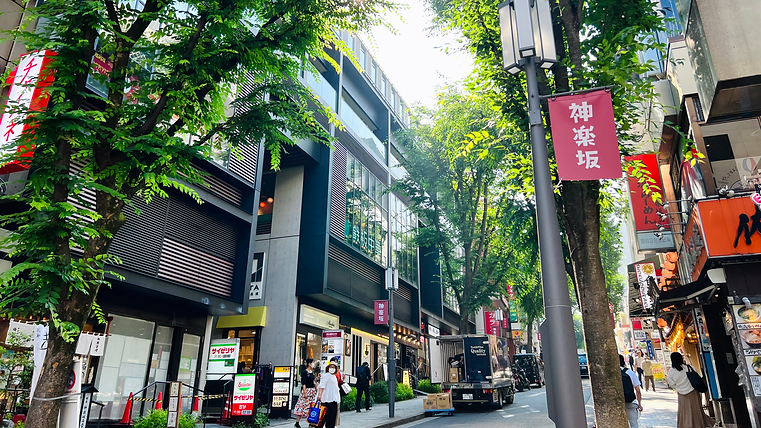
Here's some photos I took during my two-months stay at Tokyo. Enjoy :)


